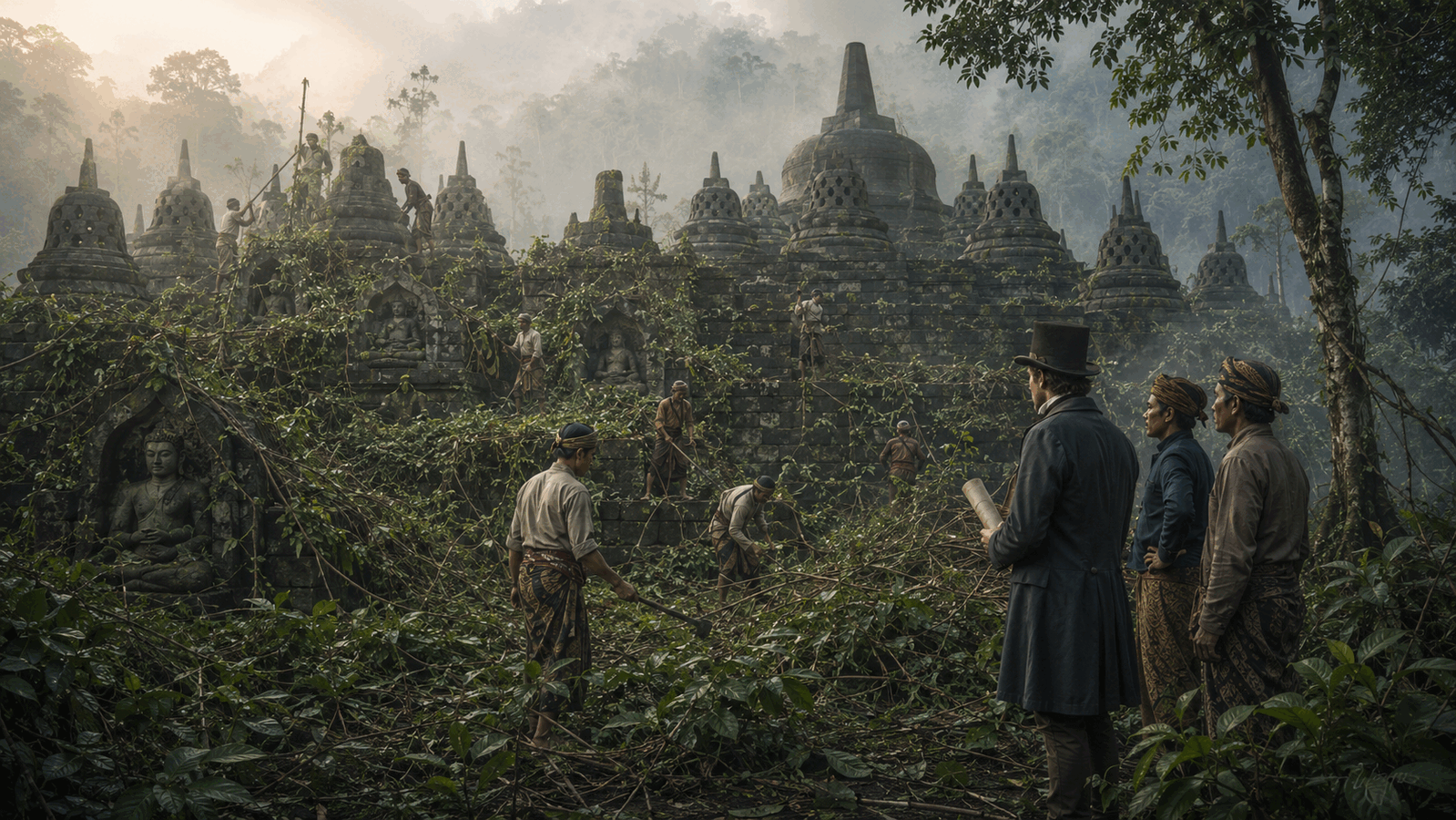
The Borobudur Rediscovery 1814 History explains how one of Indonesia’s greatest historical monuments returned to global attention after centuries of abandonment. Hidden beneath vegetation and volcanic materials, Borobudur was rediscovered during the early 19th century and later became recognized as a masterpiece of Buddhist architecture.
The rediscovery marked an important moment in the study of ancient Javanese civilization. It encouraged researchers to explore the temple’s history, design, and cultural significance.
Borobudur Before the Rediscovery
Before 1814, Borobudur had remained largely forgotten for hundreds of years. The temple lost its original function after political and religious changes transformed Java.
The movement of power centers from Central Java to East Java affected many historical sites. Buddhist traditions gradually declined, and Borobudur was no longer used as a major pilgrimage destination.
Over time, volcanic ash, soil, and tropical plants covered much of the monument. The surrounding environment made the temple difficult to recognize.
Although the structure was hidden, local communities still knew about the ancient site. Stories about the monument continued among people living near Borobudur.
Visitors can learn more about this journey through Borobudur Temple history, origins, rediscovery, restoration, and legacy.
The Discovery in 1814
The official rediscovery of Borobudur occurred in 1814 during the British administration of Java. Sir Thomas Stamford Raffles, who governed Java at that time, received reports about a large ancient structure hidden in the forest.
Raffles showed interest in the discovery and instructed officials to investigate the site. H.C. Cornelius, a Dutch engineer working under the British administration, led the early exploration.
Cornelius and his team cleared vegetation and removed parts of the soil covering the monument. Their work revealed the impressive scale of Borobudur and introduced the temple to wider attention.
Early Research and Documentation
After the rediscovery, researchers began studying Borobudur’s architecture and historical value. Drawings, reports, and documentation were created to record the condition of the monument.
These early studies helped historians understand the temple’s connection with Mahayana Buddhism and the Sailendra Dynasty. Researchers also examined the thousands of relief panels carved across the temple walls.
The documentation became an important foundation for future restoration efforts. It allowed experts to identify damage and develop methods to protect the monument.
Restoration After Rediscovery
The rediscovery of Borobudur also revealed serious preservation challenges. The monument had suffered damage from natural conditions and centuries of neglect.
Early restoration attempts focused on maintaining the structure and preventing further deterioration. However, larger conservation programs were needed to protect the temple completely.
The Indonesian government later worked with international organizations to restore Borobudur. The major restoration project from 1975 to 1982 received support from UNESCO.
Borobudur’s Importance Today
More than two centuries after its rediscovery, Borobudur remains one of Indonesia’s most important heritage sites. The monument represents Buddhist philosophy, ancient Javanese creativity, and architectural achievement.
Today, visitors explore Borobudur to understand its history and spiritual meaning. The temple continues to attract travelers, researchers, and Buddhist pilgrims from around the world.
Travelers who want to experience this historical monument can join a Borobudur Temple tour to explore its architecture and cultural significance.
Conclusion
The Borobudur Rediscovery 1814 History shows how an abandoned monument returned to global recognition. The discovery transformed Borobudur from a hidden structure into a symbol of Indonesia’s cultural heritage.
Understanding the rediscovery process allows visitors to appreciate the dedication behind preserving this ancient masterpiece. Every relief, terrace, and stone reflects a story of history, exploration, and conservation.
